What’s So Good About Good Friday?

In Omnibus II, we are learning about comedies and tragedies.  Tragic stories generally move from a state of stability or normalcy to a sad (tragic) conclusion.  They’re often characterized by death and destruction.  On the other hand, comedies generally move from bad to good, and they end happily (though not necessarily hilariously).  A good example would be the glorious story of the redemption of mankind and the victory of Christ.

This is why we can call the day on which Christ was murdered Good Friday.  The greatest comedy in history looks at first blush like a tragedy.

In truth, Good Friday was the darkest day that the world had ever seen, when the incarnate (i.e., in-the-flesh) Son of God became sin (2 Corinthians 5:21) – and was punished – for our sake, and the blackened sky reflected this tragedy (Matthew 27:45). How is this a good thing?

Well, it all starts with a problem.

##The Great Problem

For as long as men have been around, they’ve known that they’re spiritual creatures. We know in our hearts that there is an eternal aspect to our existence: the soul, the spirit, the part that does not die when our bodies do. And we know that we have been created, not that we are the result of generations of cosmic and biological happenstance. Any efforts to deny this are ultimately folly, since God has written this truth on our hearts. (See Romans 1:18-3:20 for an indictment of a race that “knows” God, whatever we may say.) We know it, but we often deny it, insisting that God doesn’t exist and that there is no objective standard for our behavior.
What's So Good About Friday?

What’s more, these same men have always known that if there is life after death – and there is – then that is bad news for us, because we are – at best – imperfect. We’ve tried from early in our existence to pacify the gods. We’ve made gods like us, but better, more like we wish we could be. They’re eternal. Big. But they’re also angry, adulterous, murderous, and capricious. These gods (read: demons) demand things of us that reflect their hatred of us and their hatred of the One Whose image we bear. In our errant worship, we destroy our souls.

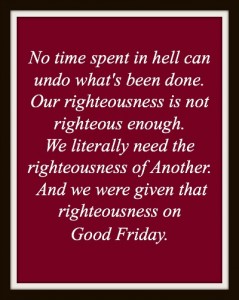
Men’s sacrifices to the gods of this world and even the True God of Scripture as He commanded in the Old Testament testify to one common theme that God has written on our hearts: sin requires sacrifice. Sin is an infinite violation of God’s holy standard, and requires an infinite payment. This is where the situation gets still more dire: men are not capable of offering a payment for their sins that is sufficient to pay for their sins. A lifetime in hell paying for sins is not long enough to change a soul’s status from sinful to sinless. No time spent in hell can undo what’s been done. Our righteousness is not righteous enough. We literally need the righteousness of Another. And we were given that righteousness on Good Friday.

##The Great Solution

At the cross on Good Friday, the God-Man Jesus Christ died a death for sinners. He paid a penalty that was sufficient to pay for the sins of all who would believe in Him. As a Man, He could pay for the sins of Man. As sinless God (without any sin of His own), He could pay for the sins of many men. He took our sins on Himself while we took His righteousness. It’s called the double transfer. Our sin was transferred to Him; His righteousness was transferred to us. He died with our sins, bearing the wrath of the Father.

But the story gets better.

The following Sunday morning – on Easter! – Jesus rose again from the grave! This is a cause for celebration for many reasons. For now, I’ll cite two:

  • It signified that the work of paying for sins was complete. If Jesus were still in the grave, the the payment for our sins would still be in process, and we would have no hope or certainty that the wrath of God had been satisfied.
  • Jesus conquered death. Death has no power over Jesus, and neither shall it have any power over His followers.

So we call it Good Friday, and rightly so. What appeared to be a defeat at the hands of sin and the devil turned out to be a glorious victory over sin, the devil and death. It is because of the work of Christ on Good Friday that we can be in relationship with the God of Scripture, that we can have any hope in the face of death. When Christians die, we go to heaven not because we have been good enough in this life, but because Christ has worked on our behalf, giving us His righteousness.

You may be wondering at this point if or how this righteousness of Christ applies to you. Well, let me encourage you with the following common Christian confessions:

  • Jesus is Lord of all (Romans 10:9).
  • God raised Him from the dead (Romans 10:9).
  • Jesus is the only way to the Father (Acts 4:12).
  • I am a sinner who needs to be saved from the consequences of my own sins and decisions.
    God alone can save me.
  • Jesus’ payment for my sins on the cross is enough.
  • I love God and want to know Him more and live in obedience to His commands.

If you also confess these things, then you can know – as certainly as God’s Word is true – that you may have a relationship with God forever as His adopted child.

May these truths give you plenty of reason to celebrate and declare God’s goodness this Easter and always.

Four Days Per Week in 2014-2015

It’s been some time since our last news post, though there’s been plenty going on at ECS.

We are excitedly making plans for next school year, and we have an Information Night coming up for prospective families, as well. I thought I’d apprise you all of one major change for next year that we’ll be announcing more completely at the Information Night, namely this:

ECS will meet for school-at-school four days per week starting in fall 2014.

Now, some explanation.

From fall 2011 when we started making plans and decisions regarding the school (which started in fall of 2012), our desire was to be a five-day-per-week day school. However, given our specific set of circumstances, this was not feasible for us year one. So we started by meeting for three days, having parents administer lessons (prescribed by the teachers) at home on Mondays and Fridays. That’s what we have done for the first two years, in fact.

We are ready, we think, to take the next step and add another day.

Some of the finer details are still in the works, as we still need to coordinate with the church from whom we rent our meeting space. But as of right now, we are looking at meeting Tuesday through Friday. Also, we will likely have the kindergarteners continue to attend three days per week (probably Tuesday, Wednesday, and Friday).

That’s as much as we can say right now, though we’re excited to be able to say that much.

We hope you can come to our Information Night, where we’d be glad to entertain your questions as best we are able.

Risus est bellum!

Jonathan

Worship and Warfare: Making Grendel and the Devil Cranky…through Song

Worship is a weapon, and singing is powerful. It’s true.

Many Christians today have no idea of the power inherent in singing God’s praises and thanking Him corporately. For Old Testament Israel, God required that they feast! That is, He required that they celebrate and make merry as they wage a full-scale war on gods of this world, and that’s what happens when we sing.

In Omnibus II, we have been reading the famous epic poem Beowulf. In it, the poet describes the villain Grendel (descended from Cain) in grand style, and particularly what makes him so grumpy. His language reflects an awareness of the relationship between good and evil that escapes many of us today:

Then a powerful demon, a prowler through the dark,
nursed a hard grievance. It harrowed him
to hear the din of the loud banquet
every day in the hall, the harp being struck
and the clear song of a skilled poet
telling with mastery of man’s beginnings,
how the Almighty had made the earth
a gleaming plain girdled with waters;
in His splendor He set the sun and the moon
to be earth’s lamplight, lanterns for men,
and filled the broad lap of the world
with branches and leaves; and quickened life
in every other thing that moved.

You read that right: What maddens Grendel above all else is the merriment coming from the mead-hall and the singing! And more specifically, he hates the singing about God and His creative work.

And though Grendel is a fictitious monster, he represents devilish creatures everywhere, including the prince of darkness himself. Our enemy hates the God of Heaven, and hates all those who are made in His image. He hates it when we are happy and he hates it when we declare to the world His goodness. He hates it when we celebrate His works and he hates it when we proclaim His word.

And we can do all of this in our singing. We sing words like these:

The prince of darkness grim,
We tremble not for him;
His rage we can endure,
For lo, his doom is sure:
One little word shall fell Him.

—A Mighty Fortress is Our God, verse 3

And when we do sing like this, we can be sure that the enemy is “nursing a hard grievance.” May we bear in mind that our worship is warfare.

A Yuletide Hat Tip to Herodotus…Courtesy of CS Lewis

Featured prominently in the first semester Omnibus I curriculum is Herodotus’ Histories (of the Persian War).  It’s a fantastic read in its own right, though some parts are certainly easier to get excited about than others.

The majority of Histories reads like an ethnography of the various people groups that comprise the Persian Empire and, later on, the million-man Persian army that fights the Greeks (and their Western allies) so famously at places like Thermopylae, Marathon, and Salamis.

Well, Herodotus has a distinct writing style that grows on the reader.  And in this style, CS Lewis published a fantastic satire in December 1954 that is perspective-aligning in its own right, but is guaranteed to elicit a smirk from any who are familiar with Herodotus.  For your benefit, I’ve pasted it below.  Read. Enjoy. And merry, merry Christmas.


Xmas and Christmas: A Lost Chapter from Herodotus

by C. S. Lewis

And beyond this there lies in the ocean, turned towards the west and north, the island of Niatirb which Hecataeus indeed declares to be the same size and shape as Sicily, but it is larger, though in calling it triangular a man would not miss the mark. It is densely inhabited by men who wear clothes not very different from the other barbarians who occupy the north western parts of Europe though they do not agree with them in language. These islanders, surpassing all the men of whom we know in patience and endurance, use the following customs.

In the middle of winter when fogs and rains most abound they have a great festival which they call Exmas and for fifty days they prepare for it in the fashion I shall describe. First of all, every citizen is obliged to send to each of his friends and relations a square piece of hard paper stamped with a picture, which in their speech is called an Exmas-card. But the pictures represent birds sitting on branches, or trees with a dark green prickly leaf, or else men in such garments as the Niatirbians believe that their ancestors wore two hundred years ago riding in coaches such as their ancestors used, or houses with snow on their roofs. And the Niatirbians are unwilling to say what these pictures have to do with the festival; guarding (as I suppose) some sacred mystery. And because all men must send these cards the marketplace is filled with the crowd of those buying them, so that there is great labour and weariness.

But having bought as many as they suppose to be sufficient, they return to their houses and find there the like cards which others have sent to them. And when they find cards from any to whom they also have sent cards, they throw them away and give thanks to the gods that this labour at least is over for another year. But when they find cards from any to whom they have not sent, then they beat their breasts and wail and utter curses against the sender; and, having sufficiently lamented their misfortune, they put on their boots again and go out into the fog and rain and buy a card for him also. And let this account suffice about Exmas-cards.

They also send gifts to one another, suffering the same things about the gifts as about the cards, or even worse. For every citizen has to guess the value of the gift which every friend will send to him so that he may send one of equal value, whether he can afford it or not. And they buy as gifts for one another such things as no man ever bought for himself. For the sellers, understanding the custom, put forth all kinds of trumpery, and whatever, being useless and ridiculous, they have been unable to sell throughout the year they now sell as an Exmas gift. And though the Niatirbians profess themselves to lack sufficient necessary things, such as metal, leather, wood and paper, yet an incredible quantity of these things is wasted every year, being made into the gifts.

But during these fifty days the oldest, poorest, and most miserable of the citizens put on false beards and red robes and walk about the market-place; being disguised (in my opinion) as Cronos. And the sellers of gifts no less than the purchaser’s become pale and weary, because of the crowds and the fog, so that any man who came into a Niatirbian city at this season would think some great public calamity had fallen on Niatirb. This fifty days of preparation is called in their barbarian speech the Exmas Rush.

But when the day of the festival comes, then most of the citizens, being exhausted with the Rush, lie in bed till noon. But in the evening they eat five times as much supper as on other days and, crowning themselves with crowns of paper, they become intoxicated. And on the day after Exmas they are very grave, being internally disordered by the supper and the drinking and reckoning how much they have spent on gifts and on the wine. For wine is so dear among the Niatirbians that a man must swallow the worth of a talent before he is well intoxicated.

Such, then, are their customs about the Exmas. But the few among the Niatirbians have also a festival, separate and to themselves, called Crissmas, which is on the same day as Exmas. And those who keep Crissmas, doing the opposite to the majority of the Niatirbians, rise early on that day with shining faces and go before sunrise to certain temples where they partake of a sacred feast. And in most of the temples they set out images of a fair woman with a new-born Child on her knees and certain animals and shepherds adoring the Child. (The reason of these images is given in a certain sacred story which I know but do not repeat.)

But I myself conversed with a priest in one of these temples and asked him why they kept Crissmas on the same day as Exmas; for it appeared to me inconvenient. But the priest replied, “It is not lawful, O stranger, for us to change the date of Chrissmas, but would that Zeus would put it into the minds of the Niatirbians to keep Exmas at some other time or not to keep it at all. For Exmas and the Rush distract the minds even of the few from sacred things. And we indeed are glad that men should make merry at Crissmas; but in Exmas there is no merriment left.” And when I asked him why they endured the Rush, he replied, “It is, O Stranger, a racket”; using (as I suppose) the words of some oracle and speaking unintelligibly to me (for a racket is an instrument which the barbarians use in a game called tennis).

But what Hecataeus says, that Exmas and Crissmas are the same, is not credible. For first, the pictures which are stamped on the Exmas-cards have nothing to do with the sacred story which the priests tell about Crissmas. And secondly, the most part of the Niatirbians, not believing the religion of the few, nevertheless send the gifts and cards and participate in the Rush and drink, wearing paper caps. But it is not likely that men, even being barbarians, should suffer so many and great things in honour of a god they do not believe in. And now, enough about Niatirb.


Working Hard to Have Fun

The following is a manuscript of a message I delivered to our students at a recent assembly. May you find as much application in it as I do.


One of the differences between schools like ECS and many other schools today is that most other educational models today try to motivate students by entertaining them. This is well-intentioned, but misguided. That is to say, many educators today think that if they can keep kids entertained, they can keep their interest, and thereby motivate them to learn.

Now, don’t get me wrong. Fun is good. It’s important. We don’t send you out to recess and tell you not to have fun. We don’t take field trips to a pumpkin patch hoping that you’ll not enjoy yourselves. We don’t have a motto like “laughter is war” without expecting some fun along the way. Ready Raggant (a stuffed raggant who watches over our K-2 students, observing how ready our students are to learn, and who occasionally brings treats to reward diligence) is for fun, but he’s first for hard work.

So here is an important difference. We want for the fun that we have along the way to be a byproduct of your hard work. It should not be fun to come to class without your homework finished, and we hope you never see it that way. It should be fun to come to class having done your part to be well-prepared for it, and confident that you’re ready for the lesson, quiz, test or activity.

Doug Wilson stated an important difference in his book The Paideia of God: “The entertainment model of education wants students to enjoy themselves; the older classical model wants students to be disciplined so they come to enjoy their work” (23).

Students who know how to work hard are guaranteed to be happier than people who hate work. You use a lot of energy hating work, and in the end, it’s a waste of time, because work is unavoidable.

Students, we want for you to learn how to be hard workers, to be diligent, because this is a certain way to be blessed by the Lord. But this takes some work, because none of us are automatically geared this way. We don’t come into the world hard workers. We come into the world selfish and lazy.

#The Disease

And left to ourselves, without the kind correcting and directing hand of God and other people in our lives, we will end up lazy and hating life, in constant need of correction and constantly missing opportunities.

So this afternoon I wanted to take a short look at what the Bible has to say about lazy people and diligent people, as we gain a better understanding of what we are trying to prevent you from becoming. Then we’ll take a look at what is promised to the diligent person. So let’s first make some observations from the book of Proverbs about lazy people (or sluggards, or the slothful. All the same guys.).

1. Even the slothful has to work.

“The hand of the diligent will rule, while the slothful will be put to forced labor” (Proverbs 12:24).

In many cases, lazy people work hard to avoid working, right? Well, according to Scripture, that plan doesn’t work. And would you rather work voluntarily or be forced to work? I’d rather work by my own decision rather than with a whip to my back. But the passage says the “slothful will be put to forced labor.” This is ironic, isn’t it? Labor is the thing he was trying to avoid!

Mr. Bowers shared with me an anecdote from Little Women, something the sixth graders are reading. In the story they thought it’d be fun to go as long as they could without doing any work. And the girls in the story soon discovered that this was not a good plan.

So don’t think that if you’re able to master laziness that it’s somehow going to get you out of work finally; Scripture says it ain’t so.

2. The sluggard brings about his own ruin.

“The sluggard does not plow in the autumn; he will seek at harvest and have nothing” (Proverbs 20:4).

“The desire of the sluggard kills him, for his hands refuse to labor” (Proverbs 21:25).

Lazy behavior leads to ruin. And it makes sense. Think about this on a big scale: Someone who is too lazy to gather his crops in the fall doesn’t make it to the spring!
Think about this in terms of a mess, too. Let’s say you are eating a wonderful dinner that your mother has made for you, and you don’t feel like cleaning up. And nobody else does, either. Eventually you run out of clean dishes, you start eating off of moldy nasty dishes (since nobody wanted to clean the dishes), and you get sick from that, but nobody wants to drive you to the hospital, and you don’t want to walk, because that’s work. So you die a slow, miserable death in a dirty house because you didn’t want to do the dishes.

Now, that’s a silly example, but you get the point. You simply can’t keep from doing some sort of work, so we want to teach you how to work.

3. The sluggard misses opportunities.

“Slothfulness casts into a deep sleep, and an idle person will suffer hunger” (Proverbs 19:15).

Now, we don’t have time to discuss all the sorts of opportunities that a lazy person can miss, but here’s a short list.

  • He misses opportunities to be used by God to be a blessing to others.
  • He misses opportunity to be blessed by God.
  • He misses opportunities for practical prosperity, whether it’s business or anything else.

He’s often too busy sleeping and being drowsy. Think about this next time you push the snooze button.

4. The sluggard is never satisfied.

“The soul of the sluggard craves and gets nothing, while the soul of the diligent is richly supplied” (Proverbs 13:4).

This applies two ways: the sluggard can’t be satisfied by his current behavior because of his own attitude, and, because the fruit of his work doesn’t satisfy!

This one is really chilling, because the whole life of the sluggard is built on selfishness. He doesn’t work because he doesn’t want to. The sluggard is never lazy for the sake of everyone else.

And maybe you can relate to this. If you were to be selfish with your time and lazy with your homework, who tends to suffer more? You or your parents? But if your goal is to not do your work in order to have fun, how fun is it to not be done with your homework at bedtime? That pattern of behavior does not satisfy.

Is laziness satisfying? No. Is hard work satisfying? Yes.

5. The sluggard makes excuses.

“The sluggard says, ‘There is a lion outside! I shall be killed in the streets!'” (Proverbs 22:13).

Now, in this part of the world when this was written, seeing a lion in the street was about as likely as seeing a grizzly bear on State Avenue. It’s not technically impossible, but it’s not very likely. The point here is that the sluggard is always finding or making excuses to not work. Does this sound familiar?

“I’m too tired.”
“It’s too hard.”
“I don’t know how.”
“I can’t do it.”
“Nobody helped me.”
“I don’t have time.”
“But it’s sunny outside.”
“But it’s rainy outside.”
“I can do it tomorrow.”

Again, does this sound familiar? Every one of them are excuses to not get busy right now. And this is lazy behavior.

BONUS PROVERBS!!

These ones are just for fun:

“As a door turns on its hinges, so does a sluggard on his bed” (Proverbs 26:14).

“The sluggard buries his hand in the dish and will not even bring it back to his mouth” (Proverbs 19:24).

#The Remedy

So, I think we’ve established that being a sluggard is bad, right? Well, I don’t want to leave you there. Our goal here at ECS is not just to help you NOT be lazy, but rather to learn to work hard. I want to introduce a new word to our working vocabulary: the word is “diligent.” We want you to be what the Bible calls, “diligent.”

I even think a modern definition is helpful here.

Diligent: having or showing care and conscientiousness in one’s work or duties.

When we assign homework, we’re trying to reinforce concepts and provide additional practice, but we’re also trying to teach you the value of diligence.

Your aim in life right now should not be to get through school by working as little as possible, but rather – if we’re doing our jobs rightly – you should be learning work well, and working well means working hard and working efficiently. It means making the most of your time and not wasting time. Again, Scripture calls this being “diligent.”
Learn diligence and you will be blessed by God. It will make you a valuable employee and a good leader, a better parent and an excellent steward of your time.

I’ll finish by again reading some of the Proverbs. And as I do, give attention to the references to the diligent.

“The hand of the diligent will rule, while the slothful will be put to forced labor” (Proverbs 12:24).

“The soul of the sluggard craves and gets nothing, while the soul of the diligent is richly supplied” (Proverbs 13:4).

“A slack hand causes poverty, but the hand of the diligent makes rich” (Proverbs 10:4).

“Whoever is slothful will not roast his game, but the diligent man will get precious wealth” (Proverbs 12:27).

“The plans of the diligent lead surely to abundance, but everyone who is hasty comes only to poverty” (Proverbs 21:5).

And we could go on, but you get the idea. What’s better? Being lazy or being diligent?

And since our desire is to see you glorifying God far beyond the classroom, we’d rather you learn the value of hard work than inflate your egos with good grades.

If, by God’s grace, we can teach you to work hard, we give you yet another key to the enjoyment of life. Work is good, and it is unavoidable. You will have to work, just like the lazy people out there. But there are tremendous blessings that await the diligent.

What Our Kids Are Learning

The following is excerpted from a recent email I sent to our parents.  Perhaps it will be helpful.

Regardless of the pedagogical approach, strategies and tactics, we are always teaching our students.  I’ve mentioned before that as a parent, while I’m thrilled at the academic lessons my children have learned at ECS, I’m even happier at the other things they’ve learned.  They delight in the people at ECS and they delight in the Lord, due in no small measure to who is teaching them and with whom they are learning.

Sonja and I have failed plenty of times and become frustrated when trying to educate our children.  Many invested parents can relate.  We have taught lessons that we shouldn’t teach, like…

  • It’s okay to be snarky with your family when you’ve got a lot to do.
  • History tests are laborious.
  • Reading is a chore.

Sadly, I could keep going.  I don’t believe these things, but sometimes I teach them to my kids through my behavior and attitude, nevertheless.  But fortunately, when I become frustrated, I’m reminded that God’s grace has proven to be abundant in the education of my kids, and – thanks much to the influence of our ECS teachers and community – our kids are learning (whether they know it or not) other things more in keeping with our school’s vision, things that most kids are not learning today:

  • There is sweetness to be found in Christian community.
  • The enemy is most threatened by happy Christian warriors.
  • Learning about our place in the river of Western Civilization is rich and fun.
  • History teaches us not only where we have come from, but also where we are going.
  • Only a worldview that assumes the pervasive lordship of Christ can rightly explain how the universe works.
  • Singing is cool.  Really cool.
  • Songs are weapons.
  • Math and science only work because of Christ’s lordship.
  • Reading is awesome.
  • And much, much more.

So, read this as encouragement that we are always teaching our kids, especially when we don’t want to be doing so…teaching them academically, or how to handle life or difficult people or circumstances.  Keeping this in mind really helps.

Music and Classical Christian Education

Music is really important to us at ECS.  We recognize there is tremendous power in music, and it has been used for centuries for enculturation across religious and ethnic boundaries. This is by God’s design, and music and song are evidently near to His heart (See: Psalms 1-150).

So we sing. We sing every day. We start our day singing a psalm or a hymn in Matins; we sing in Bible class, Science, History and Music. We use song to memorize, to internalize and to express praise.

In a message entitled The Classical School and Music, Doug Wilson has helpfully articulated why classical Christian schools are committed to music. I commend it to you all, whether you’re committed to classical Christian education or would like to see the Kingdom of Christ advanced in our time.

To whet your appetite and borrow a quote, let me offer this quotation from Wilson: “We are in the midst of an educational reformation that must include music.”

Check it out.

Risus est bellum!

Keys to Student Success

My third grader (Ellie) is now in Mr. Bowers’ Latin class, and the learning curve for Ellie, my wife and me has been steep as we’re adjusting to the system, curriculum and language.  It has reminded us some things that bear mentioning, though they are not inspired.

A little bit every day is far better than a lot on two days.

 Our Latin classes only meet twice a week, but as a teacher of languages (Spanish and English) for over ten years, I can’t stress strongly enough the value of frequent practice.  Though we cannot immerse our students in a Latin-language culture, we can practice with them daily.  And the same thing applies to all of the disciplines.
 
 Whether it’s the daily singing of the Acts through Revelation song, or the Mammals song, or the recitation of the Bible verse(s), or going through a stack of math fact cards, or reading the Bible, frequent and shorter times of study are better than cramming on Mondays or Fridays.  

Frequent and shorter is usually fresher and sharper.  

I know that my kids need breaks in order to retain their focus.  As students get older, they can go longer between breaks, but even the oldest kids (like us 30-somethings) need breaks.  Having your student recite the Bible verse or conjugations or declensions on a walk to the park is sometimes better than more formal, structured focused “school” time.  Playing the Bible class song in the car is sometimes better than at the homeschool table. You get the picture.

Happy Christian warriors have a life. 

We want our students to work hard at school and hard at home, but the “hard at home” part does not necessarily mean “long.”  Our kindergartners will not have as much homework as our secondary students, and that is by design.  But in no case do we want for our students to neglect leading robust, rounded lives for sake of homework.  Our intention is for the lessons they learn at school (academic and otherwise) to contribute to the roundness of their character.  

So, as you do the same thing, don’t feel guilty if you have your students abstain from any homework at all on Sundays, or if you send them outside to play with the neighbor kids before dinner, even if they aren’t finished with their math facts.  (Mr. Bowers is going to punch me….)  We want them to learn how to work diligently and hard, but this process is long (in fact, a generation long), and we know there are bigger things in view than punching the homework time clock.  When homework becomes busywork, we miss the point.

To be clear, I am NOT saying that they need to not return to their math facts after dinner (maybe, maybe not; that’s not the point).  But I am saying this: ECS is here to serve you, not the other way around.  We are assisting you in the enculturation of your children; you’re not assisting us.  When school is running your life, it’s time to revisit priorities. Of course, this all requires balance and wisdom.  Hard work is important, and so is robust, celebratory, vibrant living…even for kids. By God’s grace, with our collective faithfulness, our students will develop the work ethic we want for them…while finding time to ride bikes in the cul-de-sac.  

Risus est bellum!

Jonathan

A Summer Send-Off for Raggants

The following is the address that I gave the students of ECS at our end-of-the-year assembly. We thought it’d be an appropriate mental send-off for us all, so we’ve posted it here. Enjoy.

Well, Raggants, we are about to send you off to summer break, as our very first year of existence at ECS comes to an end. And we have learned a lot this year. We have learned that there is a difference between a direct object and an indirect object. We have learned that there are certain sounds that we never use at the ends of English words. We have learned how to properly punctuate dialogue. We’ve learned that before you get to break grammatical rules strategically, you have to first know them well. We’ve learned about the key millennial positions and their many implications.

What We’ve Learned

We’ve learned that life begins and ends according to the will of God, whether in the pumpkin patch or the pasture, the stable or the sickbed.

We’ve learned that there is no god like the true God, that men know exactly how lost they are, and that they are clawing and scratching for the answers that we have, by God’s grace. We have learned that it is our responsibility to share the gospel with the world all the time, with our actions and our words. We have seen firsthand how powerful it is when Christians assemble together for worship, even if it’s only for five minutes to start the day.

And I think we’ve had some fun along the way, too. Would you agree? I love Tuesdays when we gather together at 9:00 to start our week of school-at-school, and you guys are all happy and excited to be there. I love meeting with the Omnibus students when we get to talk about what we have just finished reading over the weekend. Tuesdays are awesome.

So are Wednesdays. I love the energy in our car as we are headed to school, because Ellie and Abbie look forward to Bible lessons with Mrs. Hall and Art class with Mr. Van der Beken and hanging out after school while their parents exercise. Wednesdays are great.

And I love Thursdays when we invite in the Omnibus auditors, the adults who come out to the school to talk about the things we read for Omnibus. They come out not because they have to, but because they can. That’s pretty cool, and it makes Thursdays sweet.

I love that so many of you are sad right now…that school’s ending. Abbie [Sarr] said the one thing she doesn’t like about our school is that it’s ending today, and she was literally crying in bed last night at the thought of not seeing you all every day and not having classes…and I know from talking to your parents that she’s not alone.

I love singing with you all every morning. We’ve sung 36 different hymns in the 36 weeks of school, and we’ve done so 3 times apiece. That really adds up and makes a difference at church on Sundays.

I love playing soccer with you all at recess, throwing the football, playing on the swings, or out in the barn.

The field trips have been a blast, too, and not only because you are pretty well-behaved or I’m proud to walk around downtown Seattle with such a fine looking group of students. To me, there’s a deeper meaning to all of this, and it has to do with summer.

The Lordship of Christ and Enculturation

We have seen again and again and again the ripple effects of the Christ’s lordship. If Jesus is Lord over all the world, then that makes a difference in how we live during the school day, at home, in winter and on summer break. And this is the lesson that I’d like to revisit this afternoon and shoot you off into summer vacation like with the velocity of an under-inflated water balloon launched by overzealous teenage boys. (Have you ever seen those water balloon launchers that take three people to operate? And have you ever seen how water balloons fly if they’re not super full? Whoa!)

You see, what we are doing here at ECS is, in fact, a support and a help to your parents. Your education is their responsibility. And while we realize that the help we provide is important, it’s not everything. A child’s development is itself like a river, with a bunch of streams flowing into it. These streams may be things like, dinner time conversations, visits with grandparents, devotional times, time in front of the TV, time with the kids in your neighborhood, church, and so on. Well, for the summer, the stream called “school” won’t be flowing as strongly into the river of your development as it has the last nine months, but that doesn’t mean the whole river has a big beaver dam in the middle of it. No! You’re going to keep becoming who Christ is making you over the next (almost) three months, and all of the streams flowing into your development matter.

And when you realize that, you are able to approach all of life with a special energy and enthusiasm. Everything has value; nothing doesn’t matter. The time you spend shooting baskets with the kids down the street is time you’ll never get back, and it’s something that Christ is using to change the world! And He’s also using it to change you into who He wants you to be. So be excited and shoot baskets like a Christian, like shooting baskets and impacting your neighbors matters, because it does! The way you and your family barbecue and picnic, play and pray, work and rest all matters.

Fun and Battle Training

When we get together at ECS to play soccer, sing hymns, conjugate verbs, learn phonograms, memorize multiplication tables or factoids about invertebrates, you may think this is more fun than a barrel of monkeys. That’s great. It is fun, and we want you to have fun. It’s fun for me, too. But you know what I hear over the deafening giggles and Latin chants and rhythmic rattling off of the days of the week? I hear an occasional “BOOM.”

You see, when unbelievers get together in classes and study volcanoes or geography or Anne of Green Gables, the devil is not threatened. They may even come away with a greater sense of themselves rather than a greater sense of God, and miss the point of education altogether.

But when Christians do these things, it is nothing less than an assault on the kingdom of darkness. When we assemble for school, we’re training you for war…and you don’t even know it. What we are doing in training you to be happy warriors for Christ is a real threat to the kingdom of darkness. It is nothing less than a full-scale assault on the citadels of unbelief, hence the “BOOM,” as the enemy gates are pounded relentlessly.

All of your life, the kingdom of God will be in attack mode on the kingdom of darkness, and you’re a soldier in that cause. And that makes the devil really nervous…and it should.

Imagine if there were a bunch of North Koreans “peacefully” assembled in one of the pastures adjacent to ECS, and they were doing drills, training exercises, and maneuvers. That would make us nervous, and rightly so. And if they were having a blast in the process and passers by wanted in on their party, we’d find that even more troubling.

The leading of the Christian life is a powerful weapon in our cause. You may think you’re just going about your life, but as you’re going, the Father is making you more like the Son, and the Son is purifying you to present you to Himself pure and spotless as a part of His bride, the Church. This is something that Jesus takes seriously.

So what about summer? Well, if what I’ve said is true, then it doesn’t end with the school year, right? Only one part of it (albeit significant) takes a vacation: the going-to-school part. But the preparation for war goes on, nonetheless.

Raggants, if we are miserable, the devil is happy. You know why?

First, we’re disobedient, because Christians are supposed to be joyful.
Second, there’s no chance than we’re going to draw anybody into the kingdom of God, because if being a Christian is all about boring joylessness, well? The world doesn’t need Jesus to be boring and joyless; they can do that without Him, right?

When we are miserable, we misrepresent Christ. So be happy this summer. Have fun. Have a lot of fun. God smiles at that, and the devil hates it. Just make sure you’re doing the right think along the way (i.e., no rule-breaking or disobedience to your parents with “fun” as the excuse).

I’m not saying that unbelievers can’t have fun. But what does their fun get them? Happiness for a moment? Maybe even a lifetime. I say, “BIG DEAL!” At the very best they can love the blessings they’ve been given. But we get to love not only the blessings, but the Giver of those blessings. Our fun and happiness become expressions of delight and thankfulness to God for His giving us good things.

So are you ready to put this into practice? In a moment we’re going party in such a way as to make the devil really nervous, as he thinks, “There’s a bunch of Christians up there having a whole lot of fun! I hope nobody notices.”

Well, here’s to a fantastic summer break living robust lives for Christ and growing in our knowledge of and love for Him. And by His grace, may others take notice.

–Mr. Sarr

Of Course We Are a Prep School

This is from Sean Higgins’ contribution to our recent Information Night.  Enjoy. 

A frequent knock against classical Christian schools is that they grow up into prep schools. These critics usually refer to a “prep school” as one that belabors study and grades and competition and success. A prep school defines success as high scores on standardized tests and graduates who are accepted at esteemed universities. The margin for error on these campuses is thin, just like their sense of humor.

I understand that “prep school” is a thing. But when the final bell rings, every student in every school has been prepared to do something. The question is, prepped for what? When it comes to Evangel Classical School, of course we are a prep school. We are preparing our students to worship.

We love Jesus Christ. We love Him as Lord and we love that He is Lord. His Lordship touches everything that He made and, “without Him was not anything made that was made.” In other words, nothing is not His. He controls it all, He cares about it all, and He commanded men to manage the world under His sovereignty. His wholesale Lordship is good for us since it means that everything on earth is on the table for us to examine and use and enjoy. Where do we begin as a school?

We begin with worship. We start by submitting to His Lordship. We don’t teach and test so that future graduates can take God’s place. We educate in confidence that God is in His place. “The fear of the Lord is the beginning of wisdom” (Proverbs 1:8). Education built on any other than ground than glad obedience to Jesus, whether through ignorant neglect or willful denial of His Lordship, will crumble. ECS will only be as strong as we start by depending on Christ.

Then the doors to every classroom in creation open for our study. Whether we use a telescope or a microscope, all that we see serves Him. Every verse in every book of the Bible, every sound of every letter in the alphabet, every rise and fall of every nation, every meter of every Latin poem, it all belongs to Him.

Because truth depends on Christ, we can depend on truth. Because we can depend on truth, we can spread that truth to students even when they can’t yet explain how it all works. In fact, our youngest students love gathering truth-nuggets, or what is called the “grammar” of every subject. They sing events and chant facts for fun, all the while soaking up the basics in multiple subjects. This is the first stage, also known as the Grammar stage, where we stuff their brains with knowledge.

As the students mature they start to ask more questions about why things are the way they are and how such diversity survives, even thrives, within the universe. Around junior high, when the questions (and arguments) flow freely, we work through principles of logic and practice debating with the goal of discerning what is true and fitting. This second stage, referred to as the Logic or Dialectic stage, is where we train them to better understand the world.

Then, armed with an arsenal of truth and senses trained to taste what is good, the third stage involves developing the ability to put it all into practice, especially in written and spoken forms. This is called the Rhetoric stage when wisdom takes shape and puts on nice clothes before going out.

The whole process teaches students about learning and, even after thirteen years, we will only have exposed them to the tip of Christ’s created iceberg. Whether we are counting quarters or defending capitalism, practicing cursive or mocking Greek mythology, reading about the Caesars or obeying Jesus’ command to pay Caesar his money, all of it is part of education.

This is why we do what we do at ECS. Every school is a prep school. We are a prep school, but not primarily prep for college. We are a prep school for worship. We are worshiping Christ, growing up in Christ, and learning to sing about and steward all that He’s given us.


For more on the Trivium as part of classical education, read Dorthy Sayers seminal lecture, “The Lost Tools of Learning.”

And here is a longer version of our Vision of Education, or, how we want it to work at ECS.